

FIU Engineers Built a Drone Detector That Listens Instead of Transmitting, for a Few Hundred Dollars
FIU researchers say they can detect and identify small drones by the low-frequency magnetic fields their motors give off, with up to 98.52% accuracy at 15 meters, using a sensor that costs a few hundr
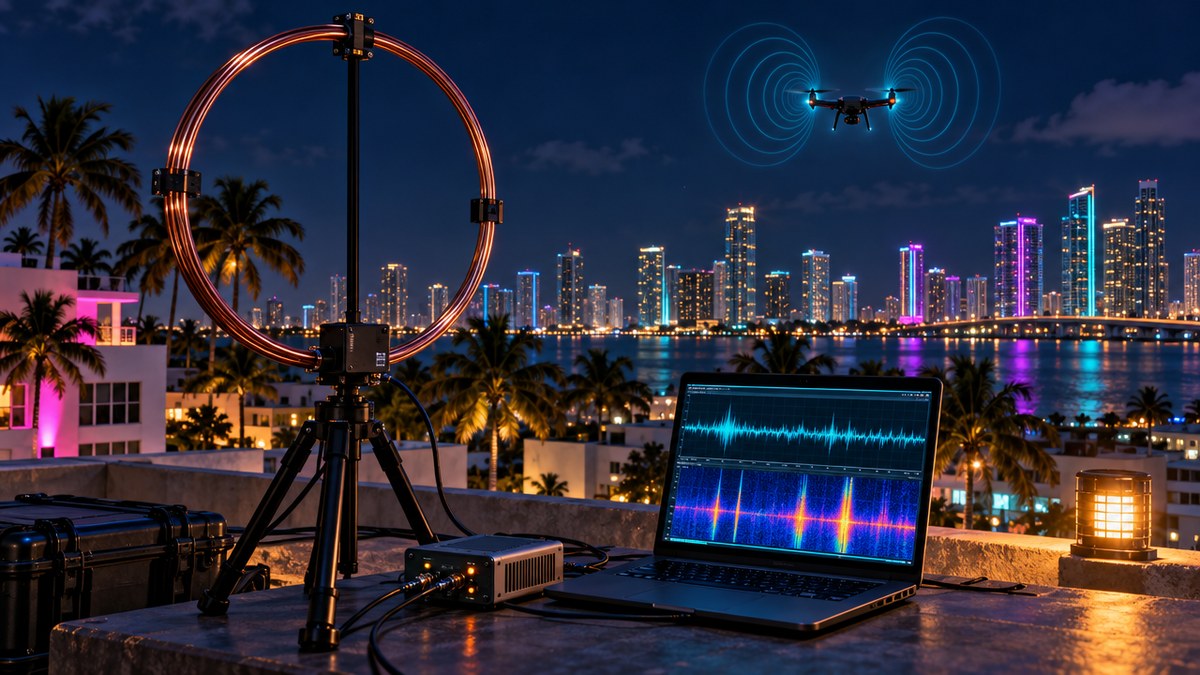
MIAMI — Most counter-drone systems give themselves away. Radar sends out a signal that can be detected, and microphones get drowned out by city and battlefield noise. A team at Florida International University says it has found a quieter and much cheaper option: listen for the faint magnetic hum of a drone’s motors.
In research announced by FIU on Oct. 23 and published in IEEE Sensors Journal, the engineers report detecting small drones outdoors with up to 98.52% accuracy at ranges of up to 15 meters. Their system could also tell which kind of drone it was hearing. Refresh Miami republished the story on Oct. 30, adding it to the week’s South Florida tech news.
How It Works
Small consumer and military drones are powered by brushless DC electric motors. As those motors spin, they give off extremely low frequency (ELF) magnetic fields, an unavoidable side effect of flight. Because different drone models use different motor setups, FIU says each model leaves “its own low-frequency magnetic signature.”
According to the paper’s abstract, the team designed a sensitive circular loop antenna and a low-noise analog front end to capture those emissions. It then turned the signals into spectral-correlation maps and ran them through a VGG16-based convolutional neural network, a common deep-learning model for image recognition. The model handles two jobs: deciding whether a drone is present and identifying which type it is.
In experiments with three commercial micro-drone platforms, the researchers reported up to 98.5% outdoor detection accuracy and 83.5% overall accuracy on a four-way classification task: three drone types plus “no drone.” Performance dropped for the smallest platform, which gave off weaker emissions, the abstract notes. The team has also posted its measurements as a public dataset on IEEE DataPort, including raw signals captured with a 1-meter loop antenna.
Stealthy and Cheap
The selling point is that the system is passive. It only receives signals and never transmits, so there’s nothing for an adversary to trace back to it.
“Every detection method currently in use gives something away. Radar transmits a signal. Acoustic systems get overwhelmed by background noise. We went a different direction entirely,” said Arjuna Madanayake, a professor in FIU’s College of Engineering & Computing, in the university’s announcement. “While the range of our method is limited for now, it costs only a few hundred dollars to develop and could run continuously without any specialized support, unlike radar systems.”
Identification is just as important as detection, he argued. “Knowing the type of drone that’s coming matters,” Madanayake said. “Different drones can carry different payloads and have different threat profiles. The more you can tell a defender about what’s coming, the better they can respond.”
The work focuses on micro-unmanned aerial systems: small, mass-producible drones that FIU notes can carry explosives or conduct surveillance while remaining nearly invisible on conventional radar.
A Big Market, a Short Range
The research arrives as defense spending on drones climbs. FIU’s release says the Department of War has requested $74 billion for drone and counter-drone technologies in its fiscal 2027 budget.
The limits are real, though. Fifteen meters is a very short detection range, and Madanayake acknowledges the range is “limited for now.” As 22Miami noted, the accuracy figures describe the team’s own outdoor tests, not a performance guarantee. FIU has not announced a deployment, a product launch or a named commercial partner. The university says only that the group “is currently working with U.S. industry to further develop the technology.”
Madanayake leads the team from FIU’s Department of Electrical & Computer Engineering. Collaborators include Sri Lanka-based researcher Chatura Seneviratne and Soumyajit Mandal of Brookhaven National Laboratory.
Why It Matters for Miami’s Tech Scene
For South Florida founders and investors, the story is a reminder that some of the region’s most commercially interesting technology is coming out of university labs, not just venture-backed startups. Defense tech and dual-use hardware have drawn heavy investor interest nationwide. A low-cost sensor that runs continuously with little support could eventually matter beyond the battlefield, for example at stadiums, ports, prisons, airports and other critical infrastructure where small drones are a growing headache.
That’s still speculative. The next milestones to watch are longer-range results, testing in messier real-world settings and a named industry partner willing to turn a lab prototype into a product. If those come through, FIU’s quiet listening device could become one of Miami’s more interesting tech-transfer stories.