

Grupo EULEN Is Bringing AI-Guided Cleaning Robots to U.S. Facilities, and Says the Real Work Happens Before They Arrive
The 64-year-old services company is rolling out autonomous sweepers and scrubbers backed by its own AI software, ELIA and E-Dash. Its pitch to facilities managers: redesign the job first, protect the
MIAMI — Most of the robots Miami talks about roll down sidewalks delivering food. One of the less glamorous jobs in any building, cleaning it, is getting the same treatment.
Grupo EULEN said on Nov. 10 that it is expanding autonomous technology across its professional cleaning operations in logistics, commercial facilities, education and healthcare, according to the company’s announcement, which carried a Miami dateline. The announcement was issued by Grupo EULEN USA through Doral-based agency DMH Americas.
The company’s message is that the machine is the easy part.
“We are not simply automating cleaning; we are rethinking how services are designed and delivered,” said Ramiro Alvarez, COO of Facility Services at EULEN USA, in the announcement. “By combining robotics, AI, data and the experience of our teams, we can create services that are more precise, measurable and responsive while respecting each client’s operational and security requirements.”
Redesign first, deploy second
Rather than dropping a robot into an existing cleaning schedule, EULEN says a specialized implementation team evaluates each client first and then redesigns tasks, frequencies and workflows before any equipment is deployed. The company calls this a service-engineering methodology.
Two in-house tools support that process. ELIA, short for EULEN Artificial Intelligence Cleaning, and E-Dash handle environmental mapping, operational data and equipment selection, according to the announcement.
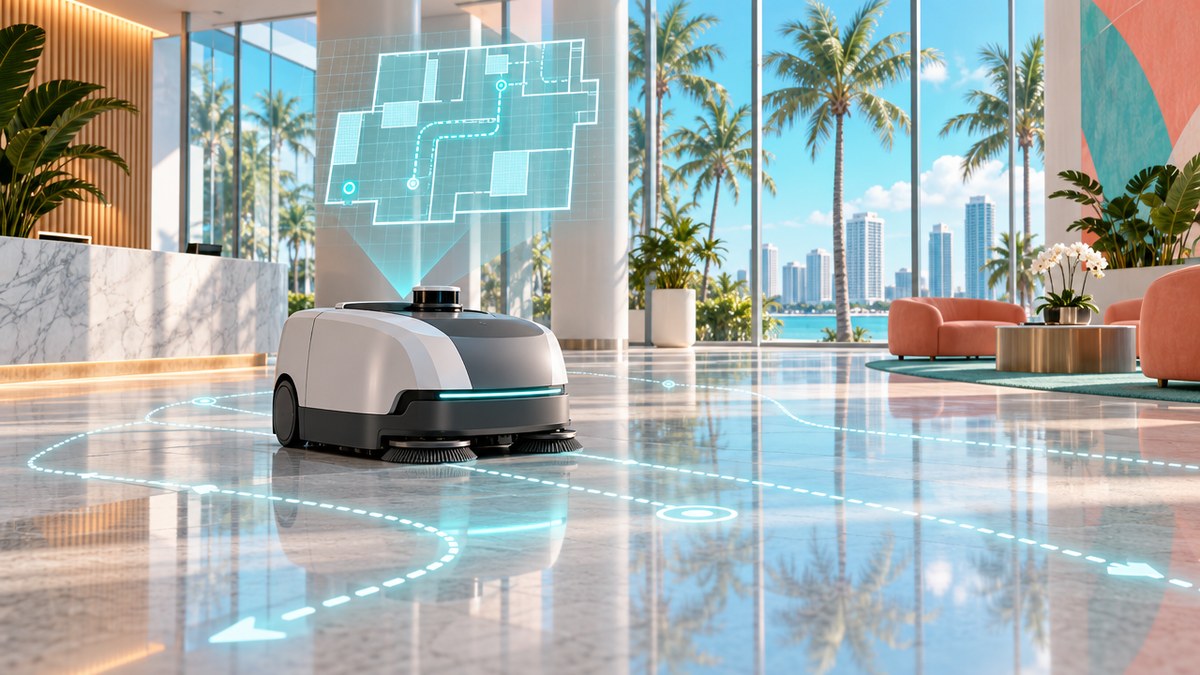
Once deployed, the robots use mapping and sensors to recognize corridors, open areas, people and obstacles, and adjust their routes in real time. Depending on the equipment, they can sweep, vacuum, scrub and mop, dispense precise amounts of water and cleaning products, and return to their charging bases on their own.
Safeguards can include obstacle and people detection, controlled speeds, emergency-stop functions, restricted operating zones and automatic route changes. The company also suggests running the machines during lower-occupancy periods to reduce disruption, which matters in hospitals, schools and busy warehouses.
A robot that maps a building is also collecting data
The most interesting part of the announcement may be its focus on security. A cleaning robot that maps a facility ends up holding a detailed picture of that facility. For a hospital, a lab or a distribution center with proprietary layouts, that is sensitive information.
EULEN says security is considered when it selects, configures and deploys equipment. Depending on the platform and the client, protections can include role-based access, encrypted data transmission and storage, secure user authentication, network segmentation, controlled software updates, audit logs and defined data-retention settings. Mapping and operational data can be limited to what is needed for cleaning, with access restricted to authorized personnel, and operating zones can be configured to reduce unnecessary collection.
The company has been building toward that pitch for a while. In June, Grupo EULEN said in a Spanish-language announcement that it had become the first company certified under the ISO 27001 information security standard for its cleaning robotics projects. That certification covered ELIA and the E-Dash data platform, according to the release.
Turning cleaning into something you can audit
For facilities managers, the most practical selling point may be the records. EULEN says its autonomous equipment can log operating times, areas serviced and performance, so clients can see when, where and how cleaning was done. The company says that information helps teams spot patterns, adjust frequencies and keep improving service.
As Miami AI News noted, cleaning is labor intensive, hard to measure and easy to cut when budgets tighten. Machines that document their own work could turn a vague service contract into something a client can check line by line.
Where people fit
EULEN describes robotics as a complement to human expertise rather than a replacement. In its framing, autonomous equipment takes on repetitive tasks so employees can focus on supervision, quality control, technical processes and work that requires judgment.
That is the question many service workers will ask about any automation announcement, and EULEN has not published figures on staffing or cost savings tied to the rollout. Miami AI News pointed out that the announcement describes capabilities, not customer results. A robot that scrubs a corridor still leaves restrooms, glass and spills to people.
Why it matters for South Florida
Grupo EULEN was founded in 1962 and operates in 11 countries, including the United States, where it has more than 16 years of experience and a presence along the East Coast from Florida to New York, according to the company. Its services range from aviation and cleaning to security, logistics, facility management and maintenance.
That mix lines up with South Florida’s economy. The region’s warehouses, hospitals, schools, offices and airport facilities all depend on contracted cleaning and maintenance, and their operators face the same pressure to do more with tight labor budgets.
The real test will be whether clients see measurable gains in quality and cost. If they do, the robots’ own logs will be the first place to look.